The Documentation Burden in Home Health
Home health clinicians spend an estimated 35–45% of their working hours on documentation. This administrative burden directly impacts patient care time, contributes to clinician burnout, and—when documentation is rushed or incomplete—creates downstream problems for coding, billing, and compliance.
The documentation requirements for home health are extensive by necessity. CMS requires detailed clinical narratives to support homebound status, skilled need, and medical necessity for each service provided. OASIS assessments add another layer of complexity, requiring precise clinical observations mapped to standardized response options.
AI-Powered Documentation: Beyond Dictation
First-generation clinical documentation tools were essentially voice-to-text converters. They saved time on typing but did nothing to improve the quality or completeness of the documentation itself. AI-powered clinical documentation represents a fundamentally different approach.
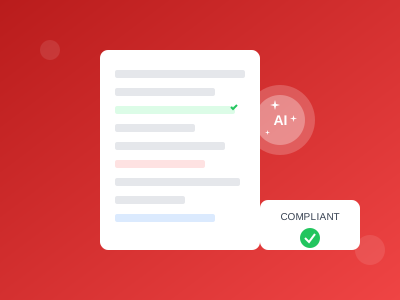
Modern AI documentation systems understand clinical context. They analyze the narrative as it is created—whether typed, dictated, or entered through structured templates—and provide real-time feedback on completeness, consistency, and compliance. If a clinician documents a wound assessment but omits measurements required for accurate OASIS scoring, the system prompts for the missing information before the visit is finalized.
Closing the Documentation-to-Coding Gap
The biggest source of revenue leakage in home health is the gap between clinical reality and coded claims. Clinicians document what they observe and treat. Coders translate that documentation into billable codes. When documentation is ambiguous, incomplete, or inconsistent, coders either query the clinician (adding days to the billing cycle) or make conservative coding decisions that leave revenue on the table.
AI-powered documentation systems close this gap by ensuring that clinical narratives contain the specificity coders need. For example, instead of accepting “patient has difficulty walking,” the system prompts for functional details: distance, assistive device use, level of assistance required. This specificity maps directly to OASIS functional items and supports accurate PDGM classification.
Real-Time Compliance Monitoring
Beyond individual visit documentation, AI systems provide agency-level compliance monitoring. They track documentation patterns across clinicians, identifying those who consistently under-document or over-document relative to patient acuity. This data supports targeted training and quality improvement initiatives.
The systems also monitor for documentation patterns that correlate with audit risk. If a high percentage of patients are documented at the highest functional impairment levels, or if wound healing trajectories are inconsistent with documented interventions, the AI flags these patterns for clinical review before they attract regulatory attention.
Measurable Outcomes
Agencies that have implemented AI-powered clinical documentation report consistent improvements across multiple metrics. Documentation completion time decreases by 20–30%, allowing clinicians to see one to two additional patients per week. OASIS accuracy scores improve by 15–25 percentage points, directly impacting case-mix weights and reimbursement.
Perhaps most importantly, the quality of the clinical record improves in ways that extend beyond billing. Better documentation supports better care coordination, more accurate outcome tracking, and stronger positions in quality reporting programs like Home Health Value-Based Purchasing.
The investment in AI-powered documentation pays for itself through a combination of increased revenue (from more accurate coding), reduced costs (from fewer claim denials and audit responses), and improved clinician satisfaction (from less time spent on paperwork and more time spent on patient care).